
Construction
Curtain walls, lift cladding, balustrades and decorative panels: the hard part is never choosing a grade — it is surface consistency, flatness, and corrosion allowance near the coast. We match the finish package to the facade and the environment, and keep colour variation inside one heat lot.
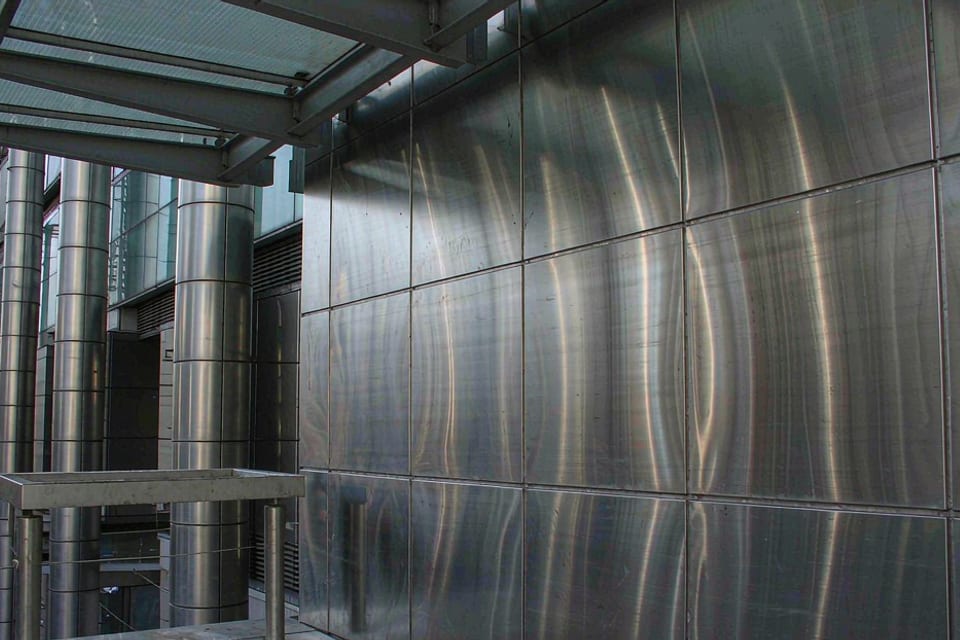
Typical parts and material selection
| Part | Grade | Surface / size | Watch out for |
|---|---|---|---|
| Curtain wall mullion / transom | 304 / 316L | 2B base, 1.5–6 mm | Flatness, consistent bend spring-back |
| Lift door frame / cabin panel | 304 | HL brushed / 8K mirror, 0.8–3 mm | No scratches, protective film |
| Balustrade / handrail | 304 / 316L | Round / square tube, Φ32–76 mm | Post-weld polishing, salt-spray class |
| Roof / canopy profiled sheet | 304 / 445M | 0.4–0.8 mm coil | Weathering, thermal movement |
| Coastal facade (< 5 km to sea) | 316L / 2205 | 2B + passivation | Chloride pitting, crevice corrosion |
Three real constraints in this industry
Colour mismatch is the real complaint
One facade must come from one heat lot and one surface process. We set aside stock per facade zone and mark the rolling lot, so nobody ends up with a patchwork wall.
Flatness decides the look
Mirror and brushed finishes amplify coil waviness. Specify 2B base re-finished for facades, and accept against EN 10088 flatness tolerances.
Coastal sites need corrosion allowance
Within 5 km of the sea use 316L; for crevices (clamps, sealant grooves) use 2205 — plain 304 rusts there within a year.
Related products
Need a quote or technical support?
Send us the part, grade, size, quantity and destination port — we reply with FOB / CIF within 24 hours.