
Automotive
Stainless in vehicles splits into two families: heat-resistant (exhaust) and decorative. Their grade systems and acceptance criteria are different, and mixing them costs you either money or a failure.
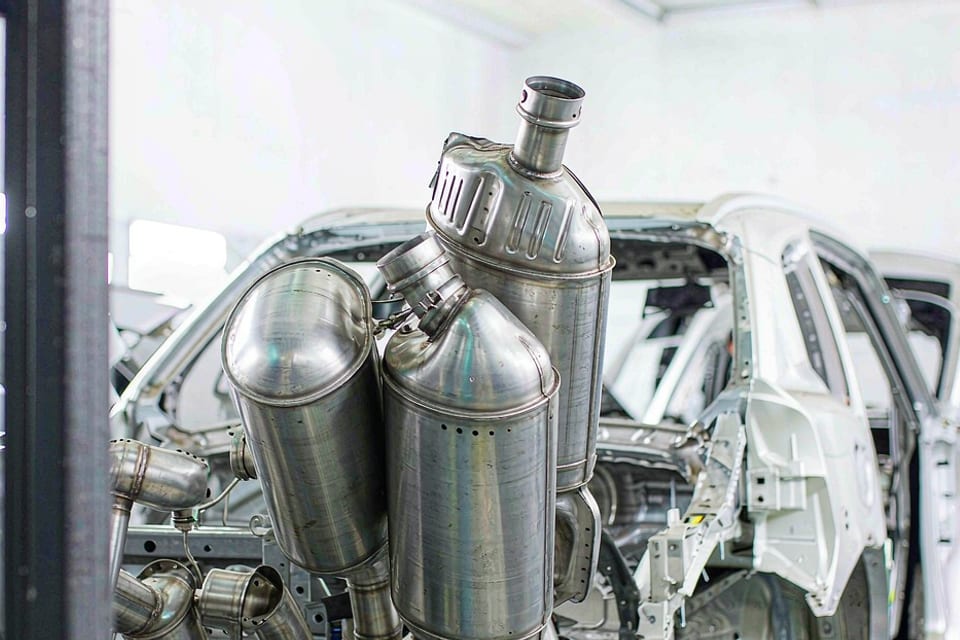
Typical parts and material selection
| Part | Grade | Surface / size | Watch out for |
|---|---|---|---|
| Exhaust manifold / downpipe | 409 / 441 | 2B / 1D, 1.2–2.0 mm | High-temperature oxidation, thermal fatigue |
| Muffler / tailpipe | 409 / 436L | 0.8–1.5 mm | Condensate corrosion |
| Trim / bright moulding | 304 / 430 | BA / 8K, 0.3–0.8 mm | Surface class, no cracking on bend |
| Fuel tank / bracket | 304 / 441 | 1.0–2.0 mm | Formability, spot weldability |
| Seat frame | 301 / 304 | High-strength sheet 0.5–1.2 mm | Yield ratio, fatigue |
Three real constraints in this industry
Exhaust is not "the more expensive the better"
409 is titanium-stabilised, cheap and adequate; 441 adds Nb+Ti for higher heat. Both mistakes are common: 304 in exhaust cracks at welds because of thermal expansion, 409 in a hot section scales.
Deep drawing depends on r-value, not hardness
Trim parts need high r and low Δr. The same grade from different rolling schedules behaves very differently — always run a drawing trial before the batch, do not just read the mill certificate.
Electrode life sets the takt time
Stainless has high resistance and low conductivity, so spot-welding electrodes wear fast. Plan electrode changes by weld count, and control incoming oil film and roughness.
Related products
Need a quote or technical support?
Send us the part, grade, size, quantity and destination port — we reply with FOB / CIF within 24 hours.