
Petrochemical
Eighty percent of plant failures are corrosion, and corrosion is decided by the medium rather than the temperature. We size the grade on chloride content, pH and whether crevices exist, and put inspection and solution annealing into the certificate.
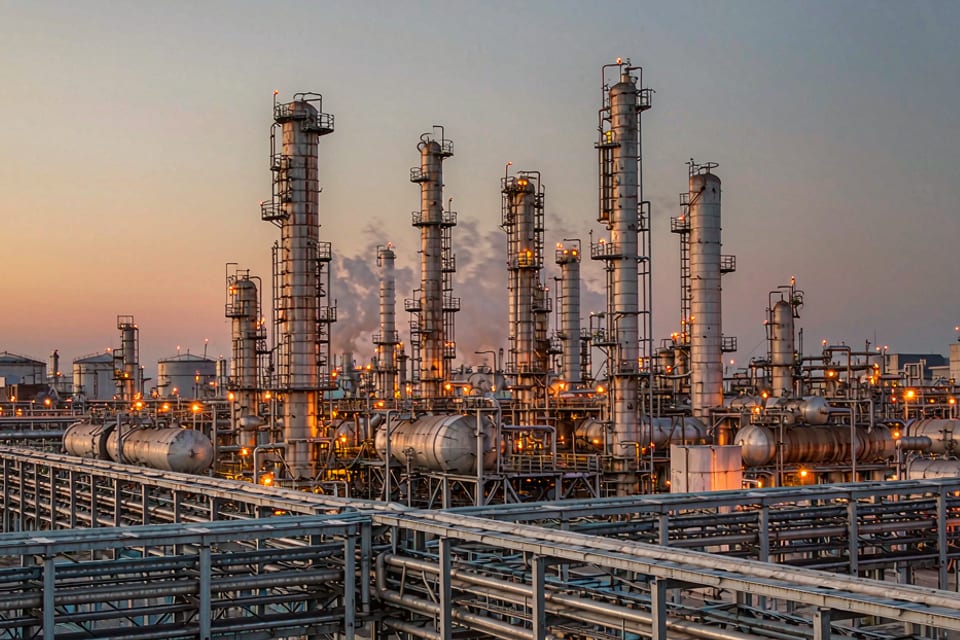
Typical parts and material selection
| Part | Grade | Surface / size | Watch out for |
|---|---|---|---|
| Atmospheric storage tank | 304 / 316L | Plate 6–30 mm | Weld quality, bottom corrosion |
| Heat exchanger tube / tubesheet | 316L / 2205 | Plate 10–60 mm, tube Φ19–25 | PREN, stress corrosion |
| Column internals / packing support | 316L / 2205 | 3–12 mm | Crevice corrosion, stiffness |
| Process piping | 316L / 904L | Seamless / welded tube | Intergranular corrosion, UT/RT |
| High-chloride service | 2205 / 904L | Full range | PREN ≥ 34 |
Three real constraints in this industry
Calculate PREN before naming a grade
PREN = Cr + 3.3Mo + 16N. 316L is roughly 24–26, 2205 roughly 34–36. Above 200 ppm chloride and 60 °C, 316L stress-corrosion risk rises sharply and duplex becomes the safe choice.
Delivery condition fails more often than chemistry
Chemical plate must be solution annealed (1050–1100 °C, rapid quench) and pickled. Buying "as-rolled" and treating it yourself usually fails the intergranular test, and cannot be fixed on site.
Put the inspection standard in the contract
Tanks and exchangers normally require UT (EN 10160 S1/E1 or equivalent) plus RT. If it is not in the contract, demanding a re-test after delivery is extremely expensive.
Related products
Need a quote or technical support?
Send us the part, grade, size, quantity and destination port — we reply with FOB / CIF within 24 hours.