
B08 · Wind Power & Storage
Stainless Steel Plates for Wind and Energy Storage: 316L/304 Selection and 7 Parts List
In wind and energy storage, we have organized 7 parts using stainless steel: commonly used 316L / 304 / 2205, with thickness ranging from 0.3–300 mm.
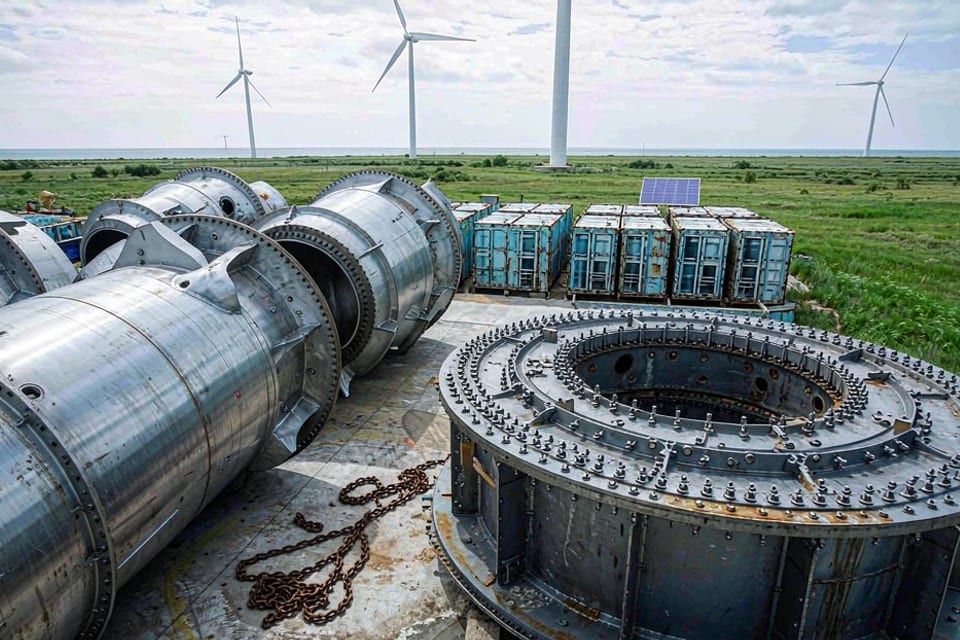
7 Parts and Material List
| Part / Component | Recommended Grade | Specification / Thickness | Surface | Main Failure Modes | Reference Standards |
|---|---|---|---|---|---|
| Tower Cylinder Flanges/Connections | 316L/2205/2507 | Flange Thickness: 50–300mm | Surface Finishing/Etching | High cyclic loads and marine atmospheric Cl⁻ lead to fatigue fracture of cylinder flanges | GB/T 3280;NB/T 47008;EN 1090;DNV/ABS |
| Cylinder/Machine Fasteners | A4-70/A4-80/2205/2507 | M8–M64 | Etching/Painting | Cl⁻ pitting, crevice corrosion, hydrogen embrittlement, and fatigue | GB/T 3098.6;ISO 3506;EN 14399 |
| Ramps/Platforms Grids/Railings | 304/316L | Grid: 3–6mm; Rail: 1.5–3mm | 2B/Slip-resistant | Marine atmospheric + splash zone corrosion | GB/T 3280;GB 4053.3 |
| Yaw/Pitch Bearings | 440C/surface hardened stainless steel | Roller: 10–50mm | Hardened and Polished | Contact Fatigue + Micro-Motion Wear + Corrosion | GB/T 308.1;GB/T 1220 |
| Li-ion Steel Shell/Lid | 304/316L(Preferred for LiFSI System) | Shell Wall 0.3–0.8mm | 2B/Nickel Plated | Electrolyte Corrosion (316L Stainless Steel Resistant to 304 in LiFSI) + Internal Short Circuit | GB/T 3280; GB/T 31467; OEM Specifications |
| Module End Plate/Connectors/Screws | 304/316L/441 | 0.8–3.0mm | 2B/Dielectric Coating | Electrolyte and Cooling Liquid Corrosion + Vibration Fatigue | GB/T 3280;GB/T 3098.6 |
| Flow Battery Stack End Plates/Manifolds/Basins | 316L/904L | 2–10mm | 2B/Acid Washed | Strong Acid/Strong Base Electrolyte Corrosion | GB/T 3280;ASTM A240 |
Inside isStandard ConfigurationSelect materials
Common grades used in this industry are 316L (5), 304 (3), and 2205 (2) —— parentheses indicate the number of affected areas, useful for quoting and material ordering.
- Corrosion sources
- Chloride ions and salt are the most common corrosion origins (pitting, crevice corrosion) (2/7 hits).
- Minimum thickness 0.3–300 mm: Thin plates are mostly formed parts (considering bend back and deep drawing cracking), thick plates are mostly welded structures (considering heat input and sensitization).
Common questions
Which stainless steel is used most in wind power and energy storage?
Out of the total 7 components, 316L appears most frequently (5 times), followed by 304 (3 times) and 2205 (2 times). Specific to a part depends on the medium and temperature; for example, stainless steel countertops that come into contact with salt water should switch from 304 to 316L.
What parts are most prone to issues?
By failure description, typical is "Tower Flanges/Connections for Offshore Wind Towers": Marine atmosphere Cl⁻ + high cyclic loads → fatigue fracture of flange bolts; recommended grades 316L/2205/2507, thickness range 50–300 mm. For this type of condition, specify media concentration, temperature, and cleaning methods in the design phase.
What thickness should I choose?
Thickness ranges from 0.3 to 300 mm. Thin plates consider forming and surface quality, thick plates consider welding and structural strength; different manufacturers may have varying values for the same part based on your drawings or conditions. Recheck as needed.
Material and Related Industries
Applications7
Thickness0.3–300mm
Grades300